The computer scientist Leonard Kleinrock, who with his mathematical theory of packet switching contributed significantly to the development of ARPANET, the precursor of the Internet, begins his article on the history of the Internet with unconventional names that are only very sporadically, if at all, associated with this global network. He mentions the scientist and inventor Nikola Tesla, who as early as 1908 was musing about a technology that “will enable a business man in New York to dictate instructions, and have them instantly appear in type at his office in London”[1], or that would enable “global access to any picture, character, drawing or print”[2]. If we mention a “permanent world encyclopaedia” in which the whole of human memory will be instantly accessible to every person; on which many people work at once; which is compact in its material form, yet enormous in its scope; which contains many clear summaries of important historical, technical, scientific, artistic and other facts; and which is a path to world peace, we do not have in mind the Wikipedia project, but rather a vision written down in 1937 by the writer H. G. Wells in his essay World Brain — The Idea of a Permanent World Encyclopaedia.[3] For Wells, this encyclopaedia represented a possible progressive complement to the traditional, conservative institutions of universities and schools. It was to be a “world organ” connecting all human minds. It is incredible how this vision from 1937, except perhaps for the world peace, was fulfilled and materialised first in the Internet network, then in the platform of the Web and finally in the already mentioned Wikipedia. Where, from today’s point of view, Wells’s prophecy falters is in the way he imagined searching this world brain. In his essay he merely mentions that information would be ordered by means of indexes. He thus leaves it to the reader to work out how browsing and linking information would function. We know that the human brain works on an associative principle, that is, it is not necessary to go back to the upper levels of a tree index in order to move on to another piece of information; instead, that information is available to us directly on the basis of association in our memory.
Vannevar Bush
The unification of the mental operations of the human brain with technology for recording, searching and sharing information takes material shape in the Memex, a device proposed theoretically after the war, in 1945, by the American engineer Vannevar Bush in the now legendary article As We May Think. Forty-four years before Tim Berners-Lee would again take up the very same question, Bush asks how the work of scientists could be improved, above all their access to the information of other researchers. If scientists had access to current research, the synthesis of information would draw on the latest findings, which would in turn improve its quality and contribute to building new information.
Before he introduces his main project — the Memex —, Bush considers whether the very recording of information could not be modernised in view of the development of photography at the time. Bush imagines a camera that a person wears “fastened on the forehead, and no bigger than a walnut”[4]. It records everything the scientist points it at. A comment and a comparison with today’s technology in the form of Google Glass suggest themselves. Bush’s portable camera on the forehead is nothing other than a prototype of the first “wearable” technology.
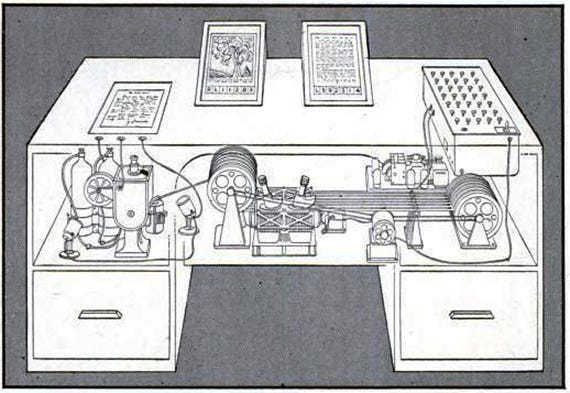
The Memex was a hypothetical electromechanical device that linked documents on microfilm. Bush called it a supplement to human memory, filled with all the records, books and communications that people have produced. Besides traditional indexing by name, Bush proposes associative indexing as a mechanism that makes it possible to move from any item to any other. The Memex looked like a piece of furniture or a desk, and the intention was that a worker would sit at it. In front of them they would have two screens on which they could not only view records but also edit them directly, using a “stylus” and interaction with the screen. Here we see an embryonic idea of the first graphical user interface: Bush suggested that by interacting with the device’s screen we can change the state of the computer’s memory. Let us of course add that in the case of the Memex this was not a modern type of computer memory, but the microfilm used at the time.
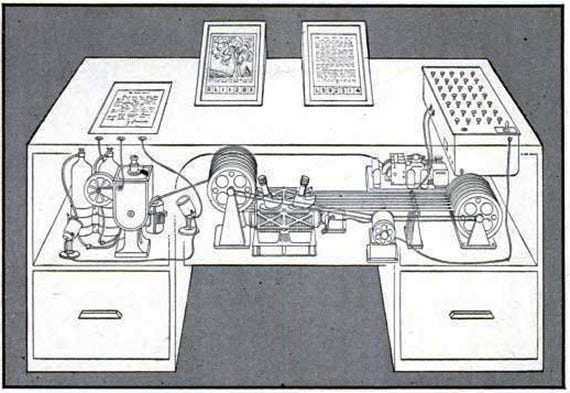
A depiction of the Memex as Bush outlined it in his 1945 article
Source: BUSH, Vannevar. As We May Think, p. 44
The whole concept would make no sense, however, if the documents could not be linked sensibly and simply. The consolidation of knowledge and the creation of one’s own “trails”, along which the user wades through the flood of information, is made possible by assigning numerical codes to individual documents (microfilms). These codes are not chosen arbitrarily, but depending on previous trails. In other words, the user is able to create new trails (which in themselves amount to creating linear, coherent narratives in a jumble of disorder) or to copy existing trails, to which they add their own new notes and photographs. Let us point out that even though the resulting trails are linear in character, their individual parts need not depend on one another in any way. Hence that simulation of the associative mechanism of human brain memory.
These trails are the theoretical basis of hyperlinks; the Memex is the first concept of a hypertext system. But we find more here. Copying existing trails into one’s own Memex and modifying parts of them recalls a process very well known in software development, so-called forking. If we use a version control system when developing software, it is not difficult to implement a new idea that could potentially ruin all the work done so far. It is enough to create a new version from the original repository — a fork. The history of open-source software development contains many interesting cases in which a fork originally grew into an entirely new and independent project. Within the topic of this work, the most interesting will be Apple’s fork, which grew out of the original KHTML project into the independent WebKit engine. The Firefox browser was originally a fork of the Mozilla Application Suite project. The newest fork in the field of web browsers came from Google, which, after long using the WebKit engine for the Chrome and Chromium browsers, created a fork named Blink.
Bush writes that “wholly new forms of encyclopaedias will appear, instantly created by joining associative trails”[5]. He also believed that a profession would arise devoted precisely to assembling new associative trails. Even though today it is not a profession as such, Bush predicted the activity of many thousands of volunteers who every day edit and add new knowledge to the largest encyclopaedia of today — Wikipedia. Finally, let us mention an idea that has not yet come true; however, looking at current developments in virtual reality and in the field concerned with connecting and communicating between the brain and the computer — brain-computer interface —, it is not out of the question that in a few years historians of technology will again mention Bush’s name in connection with the introduction of the first systems providing a direct connection to stored information. After all, Bush’s line of thought is entirely logical: if all sensory perceptions are converted into an electrical signal and the activity of the brain also consists of electro(chemical) activity, why must we first convert our desires and thoughts from electrical form into mechanical form (the movement of our hands on a keyboard) only to convert them back into electrical form?
Vannevar Bush unquestionably belongs in the pantheon of imaginative and original engineers. Bush was well aware that it was only a matter of time before the technological possibilities of the age caught up with his creative vision. Great thinkers can also be judged, however, by whom and how many followers their ideas influenced. In Bush’s case these names are big indeed, for he influenced none other than Douglas Engelbart and Ted Nelson.
A Brief History of the Web — a five-part series:
- Part 1: Nikola Tesla, H. G. Wells and Vannevar Bush — you are reading it now
- Part 2: Douglas Engelbart and NLS
- Part 3: Ted Nelson’s Xanadu
- Part 4: The Beginnings of HTML, Aspen Movie Map and HyperCard
- Part 5: From the Birth of the Web to 2007