At the mention of the name Douglas Engelbart, some may picture the creator of the computer mouse[1]. It was indeed Engelbart who needed a suitable input device for his project NLS (oNLine System). After a series of analyses of all the available devices, Engelbart sketched an entirely new one. On the basis of these sketches his colleague Bill English created the hardware design of the device, which, looking at the cable sticking out of its back, they unanimously named a mouse.[2] Engelbart’s merits, however, reach much further, and if we stopped at the mouse alone, we would belittle his contribution. Scholars point out[3] that although from today’s perspective Engelbart is known in the wider community of students and historians of new media as “the creator of the mouse”, we can just as well regard him as the inventor of the defining features of today’s computer interface, of the window metaphor in the graphical user interface and of the word processor[4]. Furthermore, Engelbart:
“[… ] helped to found the Internet; undertook research into how the computer can support cooperative work; was the first to demonstrate videoconferencing and text-and-graphics displays; created an editor for structured programming and used remote procedure calls in the 1960s; and independently invented the hyperlink at a time when Ted Nelson was working on the same idea.”[5]
Engelbart’s main philosophical programme was the desire to find a way to solve the complex questions of human society. By complex questions he meant the problems faced by the professional fields of scientists, lawyers and designers, whose solution requires, besides sophisticated methods, intuition, trial and error and a “feel for the situation”[6]. From the perspective of our analysis in the section on design, we can perhaps say that Engelbart was in fact trying to find a means or tool for solving wicked problems. As a trained engineer, he thought about how he could benefit humanity. Inspired by Bush’s article of 1945[7], Engelbart believed that many problems are caused by an unsuitable distribution of knowledge. He therefore turned his gaze to technology, since he regarded it as the main tool for “augmenting the human intellect”[8]. The French sociologist of technology and historian of the beginnings of hypertext, Thierry Bardini, remarks that, like many intellectuals of the time, Engelbart was influenced by theories of linguistic relativity[9], and so believed that “technological systems are not only shaped by people, but themselves also shape human thinking”[10]. Engelbart’s task was to design a solution that would be not only an augmentation of the human intellect, but also that supplement to human memory which Bush had called for earlier.
In 1957 he takes up a position at the Stanford Research Institute (SRI), where two years later he becomes director of the Augmentation Research Center[11] (ARC). It is here that the design and development of the revolutionary NLS system take place; in developing the individual components of this system, Engelbart’s team develops such fundamental technologies as the bitmap display, the already mentioned computer mouse, hypertext, tools for team collaboration (so-called groupware, including support for teleconferencing and screen sharing) and a precursor of the graphical user interface.[12] Engelbart’s place at the Stanford institute is significant also because it was between his laboratory and the laboratory of Leonard Kleinrock at UCLA[13] that the first two nodes of the then new ARPANET network, the predecessor of the Internet, were established in 1969.
Engelbart’s main project — NLS — arose from the conviction that computer screens could also be used to display text. Until the late fifties they had been used exclusively for military purposes, specifically for the SAGE defence radar system[14]. At the time NLS was being created, neither the Internet nor ARPANET existed, so “online” in the sixties did not mean “being on the network”, but the possibility of operating the system interactively.[15] This was achieved by using SDS 940 computers, which offered users “time-sharing”, that is, the computer’s ability to serve several users interactively at once. Every NLS page was structured into paragraphs of text of a given length. Each paragraph could be pointed to individually by means of “identifying links”. NLS contained three possible ways of referring to paragraphs: by relative position in the text; by a unique (absolute) identifier generated for each paragraph; and finally by arbitrary text strings, which most resemble the “tags” used on social networks. The NLS system further integrated the functions of email and journal entries. Both the email and the journal modules made use of the possibility of linking individual conversations and thoughts with the links mentioned, thereby fulfilling Engelbart’s main philosophical programme: to design a project that would enable better collaboration between people.
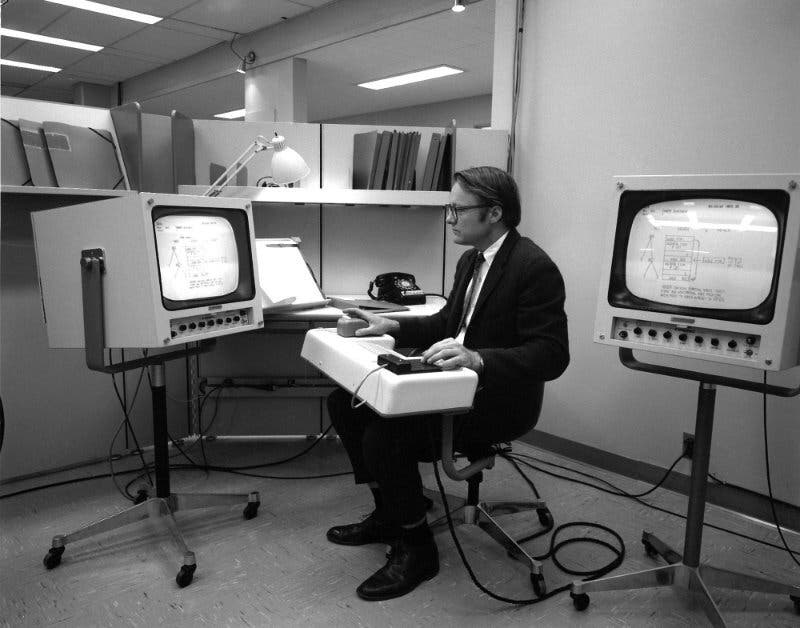
The engineer Bill English demonstrating the NLS system
Source: WEBER, CHM Fellow Douglas C. Engelbart (The New York Times)

A Brief History of the Web — a five-part series:
- Part 1: Nikola Tesla, H. G. Wells and Vannevar Bush
- Part 2: Douglas Engelbart and NLS — you are reading it
- Part 3: Ted Nelson’s Xanadu
- Part 4: The beginnings of HTML, Aspen Movie Map and HyperCard
- Part 5: From the birth of the Web to 2007
- Yes, it was Engelbart who, with his colleague Bill English, actually created the prototype of the computer mouse as we know it to this day. The Stanford institute where Engelbart worked, however, did not consider the mouse an attractive enough product, and so it sold the licence rights to the then not very well-known company Apple ↑
- MAISEL, Doug Engelbart: Father of the Mouse ↑
- WARDRIP-FRUIN and Nick MONTFORT, The NewMediaReader, p. 93 ↑
- Ibid., p. 93 ↑
- Ibid., p. 93 ↑
- ENGELBART, Augmenting Human Intellect: A Conceptual Framework, p. 95 ↑
- Biography of Douglas Engelbart ↑
- The augmentation of the human intellect is Engelbart’s main programme, which later materialises in the form of the NLS system. The English version of this phrase appears in the very title of the paper Augmenting Human Intellect: A Conceptual Framework. ↑
- The so-called Sapir–Whorf hypothesis claims that people interpret the world differently depending on the means their language gives them for perceiving the world. ↑
- BARDINI and FRIEDEWALD, Chronicle of the Death of a Laboratory: Douglas Engelbart and the Failure of the Knowledge Workshop, p. 193 ↑
- Augmentation Research Center ↑
- Biography of Douglas Engelbart ↑
- University of California, Los Angeles ↑
- FRIEDEWALD, Der Computer als Werkzeug und Medium: die geistigen und technischen Wurzeln des Personal Computers, p. 95 ↑
- MÜLLER-PROVE, Vision and Reality of Hypertext and Graphical User Interfaces, p. 7 ↑