The philosopher of art Arthur Danto was a significant and prolific philosopher and critic. Two phrases above all are characteristic of his work: “the artworld” and “the end of art”. Here I will set down notes on his essay The Artworld (in Czech translation Svět umění), which was published in 1961.
At the beginning of the essay the author comments on mimesis, that is, the first rigorous attempt at a theory of art, whose roots we trace back as far as ancient Greece, to Plato and Aristotle. The mimetic theory of art judges a work of art by how faithfully it represents or depicts reality. From this point of view it is not hard to understand why Plato was a vehement opponent of certain genres of art: Plato’s realm of Forms or Ideas contained unchanging and perfect recipes for physical as well as abstract objects, whose characteristic property was that they represented truth. Truth was the noblest aim of philosophy. For Plato, however, the artist was not someone interested in truth, since kinds of art such as poetry, painting or theatre merely imitated not the perfect Ideas but the fleeting, temporary and degrading objects of the real world. Indeed, what is more, their works were often a double imitation, because they depicted objects already made once by a human craftsman, and whatever man lays a hand on is bound to be far from perfection! At least in Plato’s eyes.
For many later theorists, though, the mimetic theory of art represented a very attractive way of judging works of art. For it offers a simple way of distinguishing good works of art from bad ones: the closer a work comes to its real model, the more it fulfils the function of art and the more valuable a work it is. This theory was popular in the Renaissance and kept its dominant position until fairly recently. Its shortcomings, as Danto writes, soon came to light after the invention of photography. For it would follow from the mimetic theory of art that any photograph would be inherently more valuable than works from any other artistic genre, whether family holiday snaps or duck-face selfies. The mimetic theory finally went under with the arrival of abstract art, in which we find no imitation of the real world at all. Nor would the mimetic theory have fared any better with Duchamp’s famous urinal and Andy Warhol’s Brillo boxes. These two works of the twentieth century serve Danto as examples of how even more recent theories that emphasise aesthetic qualities or formal elements may have trouble identifying a Dadaist urinal and a pop-art box as works of art. Danto thus asks what makes these and other objects works of art, especially when:
[…] these days one might not even be aware that one is on artistic terrain without a theory to tell one so.
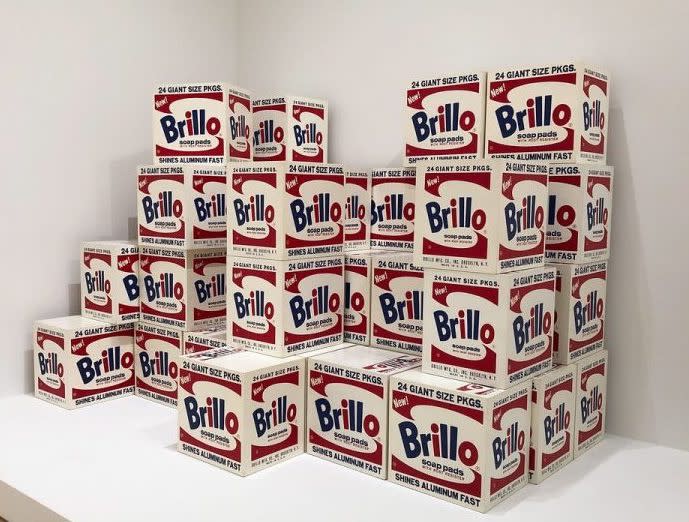
Andy Warhol’s cardboard Brillo boxes. Is it art? And why?
Danto’s radical thesis is that we should look for the “artness” of works of art not in the objects themselves but outside them, in the environment in which they exist, in the artworld and in the theories of art, for it is precisely these that make works of art possible. In other words, works of art come into being when there is a theory capable of interpreting them; theory makes art possible:
“To see something as art requires something the eye cannot descry – an atmosphere of artistic theory, a knowledge of the history of art: an artworld.”
Although works of art are certain objects, according to Danto we cannot say that works of art are merely these objects. That is what he is trying to suggest in the sentence quoted above: a work of art consists of some tangible, material part, but it is also formed by its immaterial part, which is defined precisely through its relations to the artworld, made up of theories, works, theorists, curators, museums, etc. We can thus imagine all potential works of art as existing in an abstract network, where works are connected with theories, which in turn are further connected with earlier, already existing works of art. Candidate works of art wait until this structure takes a suitable shape, one that, by way of a theory of art, casts light on them and thereby dubs them works of art.
If we return to Duchamp’s urinal or Warhol’s sculptures made of cardboard Brillo boxes, we can answer the question of what makes these ordinary objects art. Physically they may indeed be indistinguishable from their non-gallery copies, yet they are not identical. Where they differ is precisely that immaterial part, which contains the result of the interaction of the given object with the whole artworld.
For a theory to be able to interpret new works, it needs to be continually renewed and extended. This requirement is met every time the artworld takes under its wing a work that contains new properties, not yet used by earlier artists. Danto speaks of these “properties” somewhat more technically when he uses the term predicate, which we frequently encounter in linguistics or logic. In linguistics, the predicate is in general the part of the sentence that says something about its subject. Danto has in mind a particular predicate, realised as a nominal predicate with a copula. These are sentences in which the noun is followed by specific verbs such as to be or to become, completed by an adjective. Take, for example, the sentence artwork A is expressive. “Is expressive” is a nominal predicate that ascribes the property “expressive” to the noun “artwork A”. What new works of art bring, then, are precisely new predicates, which theory can use for description and interpretation. New predicates are an addition to the existing interpretive tools. The relation work of art—theory is not one-way; it can be described as a two-way, mutual interaction.
Structuralist linguistics claims that the meaning of words is given by the fact that there are other words in the language that differ from the first word, and this difference gives rise to the meaning of individual words. In other words, language can be regarded as a system, a structure (hence structuralism), in which the individual elements interact with one another, since each element contributes to, or rather participates in, the meaning of the other elements.
Although I am not well versed in structuralist art criticism, I think I will not be entirely off the mark if I declare that Danto’s theory essentially says the same thing: art is a structure made up of many elements, among which we count the works themselves, theories, institutions, etc., and their interaction (with many feedback mechanisms) and evolution (when new works, new interpretive predicates are added to the structure) form an ecosystem called the Artworld, in which the individual elements take part in the meaning of the other elements by means of synonymy, antonymy, metonymy and other relations known from linguistics. An example in painting are the abstract purists, whose:
“canvases can exist as art only because there exist ‘impurist’ paintings.”
From all this, the following logically follows for me: artists and art as a whole clearly benefit from excellent theorists. Since art is among the highest and most complex human activities, we should make sure that in the future we have enough highly educated, erudite, intelligent and creative theorists. Otherwise it may happen, if it is not happening already, that art will take anything under its wing; “anything goes” will be the standard by which new, candidate works of art will be (not) judged. Arthur Danto was aware of this. His The End of Art is a philosophical coming to terms with this problem.