Stephen Wolfram is known to the wider public thanks to the popular WolframAlpha project and also to Mathematica, his sophisticated software for various kinds of mathematical computation. But Wolfram is also a prolific scientist who was writing textbooks on particle physics at thirteen and who, relatively late by his standards, that is at twenty, earned a doctorate in theoretical physics. These biographical facts are important to know, because Wolfram’s ambitious work with the no less arrogant title A new kind of science is either the work of a genius or of a madman. His work is so radical that it is most likely the work of a man who embodies both extremes. And what is it about?
According to Wolfram, it had so far seemed obvious that complex behaviour also requires complicated mechanisms that make the behaviour possible. His work on cellular automata, however, revealed the opposite. Cellular automata are N-dimensional spaces (mostly 2D, though) consisting of a grid of discretely separated cells. Each cell can take on X different states, depending on a transformation function that usually takes into account the current state of the cell, its position and the states of the neighbouring cells. The transformation function is applied each time T increases by +1. Time is thus also discrete and symbolises the notional evolution of the individual “generations” of cells.
Watching the individual cells evolve into unexpected and interesting shapes, compounds, or better, “organisms”, is fun in itself, even though we will not find much complexity here at the conceptual level. That is probably why John Conway, the mathematician and creator of The game of life, is so irritated that the world will most likely remember this toy from his work rather than his mathematical research.
Wolfram, however, sees cellular automata as something more than just a toy. In his book A new kind of science, Wolfram argues that essentially everything in the universe, whether natural or artificial, is at its core a process that follows a set of rules, and is therefore equivalent to computation (Wolfram, 716). What is more, Wolfram believes that there is an upper limit in the universe that defines the maximum complexity of computation, thereby de facto postulating a new physical law. For Wolfram, the upper limit of computational complexity also means that all computational processes are equal to a Universal Turing machine or, precisely, to a cellular automaton.
Wolfram describes how the first glimpse of this (for him) radical idea came when he had a computer generate all possible cellular automata, which were an enumeration of simple rules for how the individual cells should behave. Most of the variations showed no surprising behaviour; often they led nowhere after a few generations, or settled into a repeating pattern. A few variations, however, surprised Wolfram, because, at least on the face of it, they showed random and complex behaviour. That was an epiphany. Later, a collaborator of Wolfram’s proved that these rules are Turing-complete, in other words that they are equivalent to all possible computational processes. Wolfram claims that there is an N-dimensional cellular automaton that, after X generations, will lead to our universe.
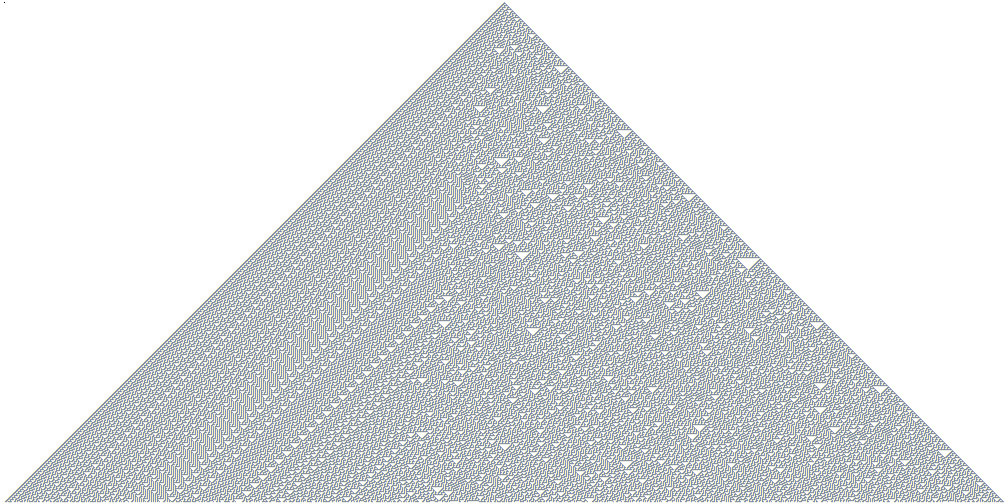
The cellular automaton called Rule 30
Source: WangPublic, Wikimedia Commons (CC0)

The reader will have noticed that throughout the text I have attributed every claim explicitly to Wolfram. That was of course deliberate, because one cannot entirely agree that Wolfram’s work was really as radical as it seems. Certainly, Wolfram is a genius, and in his 1,000-page book he argues strongly for understanding the world, and with it physics, as computation equivalent to a cellular automaton. The trouble is that Wolfram is not the first to have come up with this idea.
Another genius, the German Konrad Zuse, came up with the same idea in the 1970s. Like Wolfram, he was already proposing back then that the universe is discrete and isomorphic to a cellular automaton. In his paper Rechnender Raum, which was translated by MIT as Calculating Space, he puts forward not only his thesis but also the idea that in the future physicists should draw not only on the findings of mathematics but also on those of computer science (Zuse). Zuse thus laid the foundation of what later became a new field, digital physics.
ZUSE, Konrad. Rechnender Raum (Calculating Space). Elektronische Datenverarbeitung. 1967(8), 336–344.
WOLFRAM, Stephen. A new kind of science. Champaign, Ill.: Wolfram Media, c2001. ISBN 1-57955-008-8.