In 1999, when Google had roughly 8 employees, the computational linguist and artist Maciej Wisniewski released his project Netomat, a web browser and search engine in one. It was not, however, a real alternative to the web browsers of the time (Netscape or Internet Explorer). On the contrary, with the project the author wanted to critically re-examine the paradigm, dominant to this day, of browsing the internet through a collection of relatively static web pages. Netomat let the user enter commands in natural language (his training in computational linguistics surely came in handy for Wisniewski), which netomat interpreted. Netomat responded by displaying freely moving text, photographs and videos in many existing formats on the user’s screen. The core of the idea was that browsing the web need not mean content displayed within a single static web page. Wisniewski thus deliberately went against all the principles of user interface design, which is supposed to be accessible, friendly and help people find relevant information as quickly as possible. In Wisniewski’s own words, it was an anti-browser (Wisniewski). Netomat was, moreover, a modular and extensible browser that did not privilege any one particular look for displaying data. It was therefore up to the users to create, using netomat’s markup language, the interface in which they wanted the data displayed.
From today’s perspective, netomat resembles not so much a browser as a crawl bot, which internet search engines use to index pages. Even today, though, netomat can be considered an important project, because even after so many years the web has not changed much: yes, we use asynchronous content loading, HTML5, CSS3 and modern JavaScript, and web design also looks completely different, but we have not yet fully overcome the paradigm of the web browser and the web page.
Liberation from rectangular windows might come from augmented and virtual reality, where the interface is the world itself, whether real or virtual.
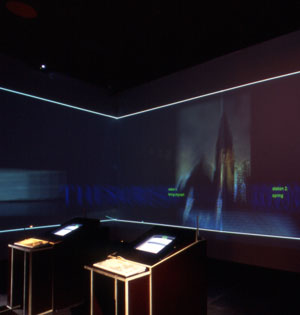
netomat at the Data Dynamics exhibition at the Whitney Museum (2001)
Source: Whitney Museum of American Art, artport
The author himself applied this joining of the world and the free flow of data at the net art exhibition Data Dynamics at the Whitney Museum in the United States, where the data were projected onto the walls of the room, and with it Wisniewski contributed to the first ventures into the artistic visualisation of data and into data art.
WISNIEWSKI, Maciej.
Netomat
[online]. [cited 2016-09-18]. Available at: https://web.archive.org/web/20000614113725/http://www.netomat.net/