Ever since filmmakers added computer technology to their repertoire, they have gained a certain kind of freedom that used to be available only to software developers: computer code has many constraints, including the need to reckon with the limits of hardware, but the laws of physics are certainly not among them. In other words, the worlds created by film and software makers need not contain the laws of physics, nor anything else from our world; their worlds are limited only by the creativity of their creators.
Creativity as a theoretical concept still brings more questions than answers, which is hardly surprising, since many theorists call creative thinking the pantheon of the highest human thought, which shows itself, among other places, in the interdisciplinary field of artificial intelligence, where achieving an AI capable of creativity is considered the point, the singularity, at which the machine replaces the human.
One does not need to know in detail how creativity manifests itself in human thinking for theorists to state what I consider a common sense thesis, namely that however creativity works, people never create things ex nihilo, but in creating refer to already existing ideas, objects and the world. This is how the philosopher Nelson Goodman argues, for example, when in his book Způsoby světatvorby he implicitly rejects the idea that a person could create without bringing into the creation both themselves and the socio-cultural context in which they create. Goodman writes:
“Worldmaking, the making of worlds as we know it, always starts from worlds already on hand; the making is a remaking” (Goodman, 1996)
We can further lean on prominent design theorists who agree with Goodman. The architect, theorist and mathematician Christopher Alexander writes in his book Notes on the Synthesis of Form that “the process of design must be seen as a process of error correction”. According to the author, “we are quite incapable of formulating a design problem except as the errors we have discovered in past solutions to past problems” (Alexander, 1971, p. 8).
The theorist Jan Michl agrees when he sees design as redesign. Michl argues that every functional, complete product, as the output of design activity, is not created ex nihilo, but is inevitably “the result of redesign, i.e. the result of the work of many designers, or rather of the gradual small and radical improvement of previous solutions, whereby none of the individual participants in this process is able to foresee or plan the complexity of the later solutions” (Michl, 2012, p. 24).
If we want to gather further evidence supporting these theses, nothing stops us from looking at contemporary philosophical theories of creativity. Since I have already undertaken this journey towards understanding creativity, I will only sum up here that contemporary theories of creativity do indeed lean towards the view that the creation of new, functional and useful things (creativity) can be seen as a developing, evolutionary process dependent on the context in which those things come about. In other words, creativity does not seem to be absolute, but must be compared within a given frame of reference, which means that what is creative for a European need not be at all interesting for an inhabitant of South America.
If at least some of these theories have anything to do with how we create and evaluate creative results, a logical and potentially quite useful pedagogical theory and practice opens up before us at once: what a student of any creative field can do straight away to improve significantly in their field is to get to know current creative results, to reflect on why they are the way they are, which previous solutions they developed from, which earlier problems they solve, or which new problems they bring, and finally to create their own new solution on their basis.
As far as the development of interactions between humans and computers is concerned, films are an especially interesting source of inspiration for many obvious reasons. For example, the budget of a blockbuster runs to entirely different figures than traditional projects creating interaction interfaces, and although I do not deny low-budget projects the possibility of coming up with interesting new results, in today’s capitalist market economy innovative, large-scale projects are mostly born on two fronts: where there are enormous sums of money, and where there are enormous sums of money. No, that is not a typo; I of course mean entirely different fronts: the private corporate sphere and the public sector in the form of university institutions and other research centres.
Both grand sci-fi films and the students at the MIT Media Lab will always start from previous solutions. The question is how sci-fi films actually use their enormous budgets and many talented people to move the field of interaction design forward, by which I also mean the academic field of HCI, if they do so at all. An equally interesting question is how big-budget films such as Ridley Scott’s Prometheus draw on existing academic and commercial research, which they implement in their work. I will focus on these and other questions with the help of the film Prometheus, by selecting, at my own discretion, an interesting interface from the film, which I will analyse in more detail by answering prepared questions.
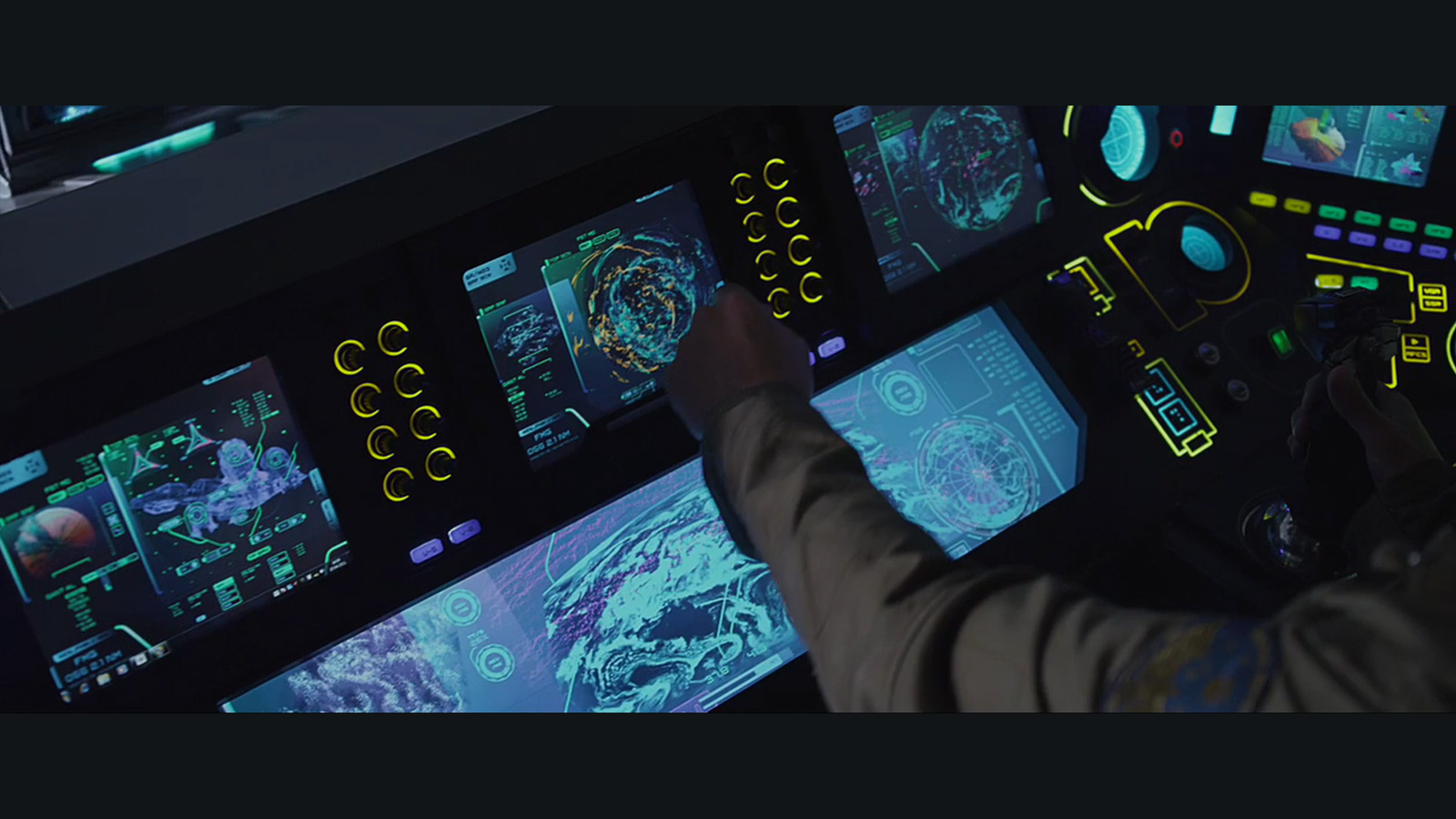
An example of the graphical interaction interface from the film Prometheus
Source: Territory Studio, the authors of the interfaces for the film Prometheus
Compared with the other technology in the film, I am choosing a fairly dull object. It is a glass or plastic, in any case transparent, “smartpad” tablet on which, according to the film, data can be displayed.
If such technology were used in an ordinary household, what would it look like?
The main reason this technology and its interaction design caught my interest is that, in my opinion, this kind of tablet will soon come onto the commercial market, where it will replace smartphones and tablets. It will be a glass pane with all the circuitry needed for touch control and for displaying any content integrated into it. Its tremendous advantage will be that one piece of hardware can display any software, so users will most likely keep this pane much longer than today’s smartphones, because such a generic and neutral look can hardly be surpassed for the given function; the engineers and designers who will design these panes will not have to deal with the aesthetic side of the device, and will instead think about what software, functionality and interactions to create.
What implications would the mass adoption of such technology have (where it could be used, ethical questions, etc.)?
It would also mean a reduction of the waste that stems from today’s smartphones and tablets being considered obsolete only because of their look and not necessarily because of their hardware. Such a generic look would stimulate the allocation of finances and human resources to the development of new interactions and functionality. At the level of society, the mass adoption of glass panes as portable display devices would mean sparing nature, less waste, better recycling of material, and thus a more ecological and cleaner world, provided that the production of this technology is not demanding and polluting.
How is it inspired by the present, and how could it influence the future of HCI?
Conceptually, similar glass panes are already fairly dated. For several years now, before the release of each new Apple iPhone, unofficial concept designs have appeared on the internet that use transparent materials and a modern visual and interaction language.
Microsoft also made its mark on wide public awareness when it released its excellent video presenting, as part of its Office product, productive life in the year 2019. Glass panes with sophisticated software and interactions are presented in this video as indispensable helpers in working life and education, but also in everyday activities.
Microsoft’s concept video presenting professional and private life in the year 2019
The concept videos from Microsoft (and others) nicely foreshadow the direction of development not only of interaction design, but of the whole discipline of HCI: hardware recedes into the background, and much more important is the software functionality available across the spectrum of devices. If potentially every surface becomes a canvas for interaction between human and computer, it is inevitable that the future of HCI will be far more oriented towards a holistic conception of interaction. That will not be an interaction between a device and a human, but a deeper fusing of the human with the computerised surrounding world. The world, it seems, will be one big “interaction canvas”. Such a synergy of the human and the artificial requires a vocabulary found today in sociology and cultural studies, but also in systems science and cybernetics. Designing interactions will mean designing life itself.
What could happen if the technology did not work, or worked badly/hacking?
If I have described the glass pane as a symbol of massive interaction with the surrounding environment, I do not mean to suggest that the film does not reckon with this vision. It in fact contains scenes in which glass really is a canvas for interaction and the control of complex technology. If I am to consider what would happen if we were all too dependent on such massive interaction with the world, it is worth recalling the opening scenes of Prometheus, in which the robot David wakes the crew from hibernation, which is provided by hibernation pods. These are controlled by visual interaction elements displayed on a glass body. When touch control stops working on personal handheld devices, nothing much happens; for devices used in sectors such as healthcare, which require one hundred per cent functionality, the consequences will be fatal.
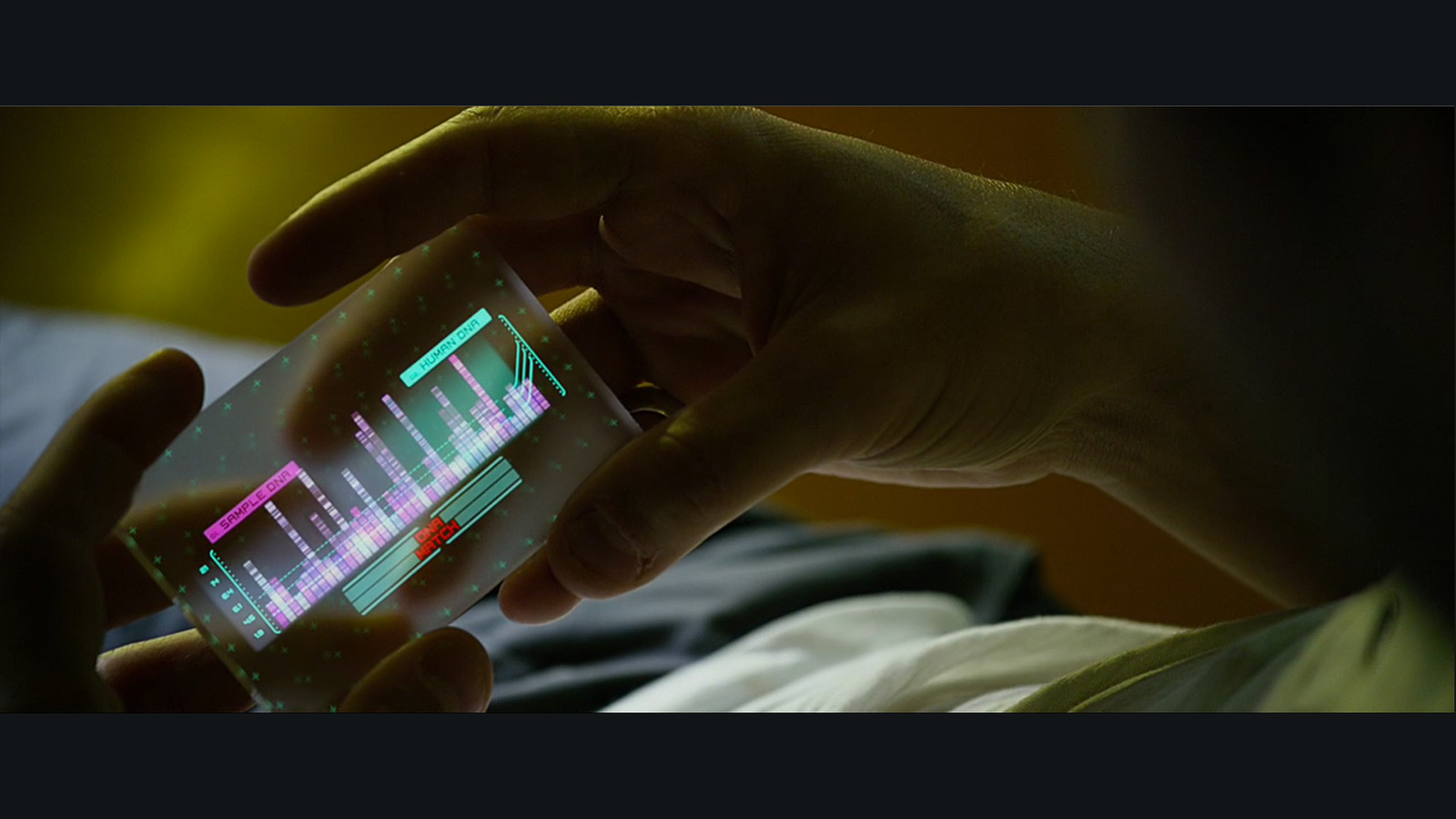
When touch control stops working on personal handheld devices, nothing much happens; for devices in fields such as healthcare, where one hundred per cent functionality is required, the consequences will be fatal
Source: Territory Studio, the authors of the interfaces for the film Prometheus
References:
ALEXANDER, Christopher. 1971. Notes on the synthesis of form. Cambridge [Mass.]: Harvard University Press. ISBN 0674627512.
GOODMAN, Nelson. 1996. Způsoby světatvorby. Bratislava: Archa. Filosofie do kapsy. ISBN 8071151203.
MICHL, Jan. 2012. Funkcionalismus, design, škola, trh: čtrnáct textů o problémech teorie a praxe moderního designu. Brno: Barrister & Principal. ISBN 9788087474488.