At the most general level, BioArt is an artistic practice in which the imaginary artistic canvas and material are living, biological organisms, their processes and behaviour. Alongside artistic methods, the artists also appropriate methods traditionally used in scientific disciplines.
Because BioArt moves on the boundary between the living and the artificial, it also raises ethical questions. The artists are aware of this, and many of them understand their bioart projects as a probe into what is socially acceptable in the context of modifying biological organisms and genetic engineering. That is also why one of the best-known bioart projects, Eduardo Kac’s fluorescent bunny Alba, is not only about creating the “object” itself (a genetically modified rabbit), but also about the social reception of the work and about provoking a discussion of how the scientific method of genetic engineering can influence, or already influences, our traditional understanding of nature, of biology, of the dichotomy of the natural and the artificial, and so on.
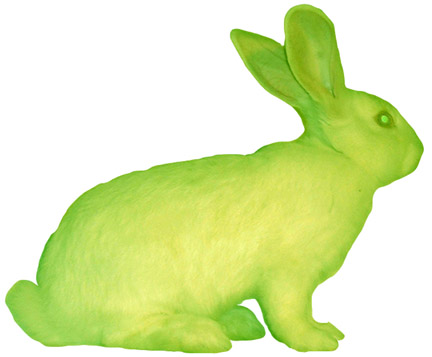
With the arrival of the CRISPR method, by which we can really modify the genetic code of an organism so that the changes introduced propagate further into subsequent generations, the ethical problems that Eduardo Kac’s “transgenic” (= transferring genes across organisms) project innocently drew attention to multiply considerably. On the one hand it is, for example, desirable to modify mosquitoes so that they do not transmit malaria; or, somewhat more controversially, to offer parents the option of removing from an embryo the genes that increase the likelihood of a serious disease or disability manifesting itself. But if editing human DNA really became a common method, a purely scientific method would become a political and cultural problem, raising the questions of who will have access to these methods and when. Will they be part of public healthcare, or only a procedure for those who pay for it? While the Western world consciously regards such questions as taboo, which certainly does not help critical examination and discussion, China has quietly become a scientific power in genomics and genetic engineering. China’s one-child policy is in fact a form of social engineering, and China eagerly monitors children from an early age so as to be able to predict and recommend what the children should devote themselves to in life. CRISPR, it seems, will be just another method for China to continue its endeavour.
The Western world does not even want to hear about such projects. The question is how long we will be able to bury our heads in the sand; how long will it take before the better-off travel to countries where genetic modifications will be legal, in order to secure for their children and for themselves the behaviours and functions they will consider beneficial?
BioArt, in my view, can break through this amnesia by stirring up awareness of what is possible not only technologically but also ethically.
In our self-absorption, aka good old anthropocentrism, we could easily forget that the interaction of the living and the artificial brings controversy on the other side too: in the artificial. It is quite possible that on the way to a purely artificial intelligence we will pass through an intermediate link, namely the cyborg. For creating a new form of intelligence is, it seems to me, a much harder task than merging with the already existing human brain, created by evolution. Revolution will be preceded by evolution. Only quantitative changes will lead to qualitative ones.
One of the high-tech bioart projects that attempts to create a cybernetic organism is the work of the Slovenian artist Maja Smrekar. Her project Ion Flux / First level from 2010 involves the use of a biochip that electrically stimulates neuronal cells and at the same time reads the output of the signals the cells send back. The stimulated neuronal cells form a neural network that will learn and retain the changes from learning in a formed memory. The purpose, in the artist’s words, is to create through this process an “emancipated being” whose behaviour will depend on the structure of the neural network, which, as in humans, changes depending on learning. (Ion Flux / First level).
Many well-known futurists, with Ray Kurzweil, for example, at their head, believe that artificial intelligence will not be mere fiction in the near future, but reality. As soon as that happens, artificial intelligence with a digital mind and practically unlimited computing power will surpass the human brain, about which Kurzweil writes:
“The human brain contains 100 billion neurons, and there are 1,000 connections between two neurons. These connections work very slowly, at the level of 200 calculations per second. But 100 billion neurons multiplied by 1,000 connections make a parallelism on the level of 100 trillion. If we multiply this number by 200 calculations per second, it makes 20 million billion calculations per second, or, in computer terminology, 20 billion MIPS. And we will have 20 billion MIPS for 1,000 dollars by the year 2020.” (The human machine merger: are we headed for the matrix?)
The law of the exponential growth of the evolutionary process, which Kurzweil often promotes, tells us that in 2055, for the same price, we will get a processor with the power of the brains of all the people on the planet. With these numbers, the current dabbling in the problematic ethics of Chinese research, or fears of technological unemployment, seem trivial. Yet they stem from the same principle: the exponential growth of the power and capabilities of technology.
In the last few years, mainstream culture has indeed begun to talk more about the influence of technology and (anthropomorphised) robots. That is only the surface of what artificial intelligence means: the future relevance of humanity. But perhaps there is a simple solution. If we ban the development of this technology. That, however, would require a consensus of all the countries and institutions capable of such technically demanding development. That does not seem likely to me, for there are several reasons to set out in this direction; economic and military dominance are the first that come to mind.
How long will humanity as an organism last? Who knows, but it seems that if in a few years we want to match the entities we ourselves have created, we will have to re-design ourselves and implement at least something of what we have put into the creation of AI. We will merge with technology. We will have to. And it is time for this concept to penetrate the collective consciousness and imagination of humanity. Art is very well placed for this, for besides concepts and theories it can produce perceptible objects which, as manifestations of ideas, are more accessible to a wider audience. BioArt, as artistic research into the symbiosis of the technological and the organic, has a crucial role in disseminating ideas and educating the audience about what will be an epoch at least as significant as all the previous technological revolutions put together.
Technology as the challenging of nature will swallow its creator too. Heidegger already warned of this. How destructive an event it will be, we do not know. But the whole dichotomy of the human and the artificial will suddenly appear all too human.
Sources:
Ion Flux / First level (2010). Maja Smrekar [online]. [cited 2016-09-17]. Available at: http://majasmrekar.org/ion-flux
The human machine merger: are we headed for the matrix? Kurzweil Accelerating Intelligence [online]. [cited 2016-09-17]. Available at: http://www.kurzweilai.net/the-human-machine-merger-are-we-headed-for-the-matrix