The beginning of the film’s story seems innocent. We follow a talented linguist, Louise Banks, who in the opening scenes lives through a family tragedy — the death of her daughter. Cut. The film moves to the present: Dr Banks, with a tired look on her face, arrives to teach in a vast university lecture hall. The room, however, is half empty and most of the students are missing. As if that were not enough, the phones, tablets and other devices of the few who are present start ringing. Something is happening. One student asks the doctor to switch on the news on the television.
Exactly twelve egg-shaped spaceships have positioned themselves around the planet. Their appearance is mysterious — the material resembles worked stone, so the ships look like enormous levitating pebbles. Cut.
Dr Banks is sitting at the desk in her house by the lake when she is visited by an unexpected guest with sharp features — Colonel Weber. On a portable device he plays her a sound that vaguely resembles a dog shaking off its wet coat. It is a recording of communication with the newcomers. It is not possible for her to decipher a whole language from a single sound. For that, one has to meet the aliens in person, to enter into interaction with them. The colonel does not understand why the recordings should not be enough, and refuses to say more. In the end, however, Banks joins one of the many teams around the world trying to figure out what is going on. She is taken to one of the ships, near which a makeshift military camp has been set up, where she is to work. She will be helped by the second main character of the film — the theoretical physicist Ian Donnelly.
Unlike the older film Contact, where the aliens made communication easier by appearing in the form of the heroine’s father, Arrival (Czech title Příchozí) approaches language differently: it builds the plot on the process of uncovering linguistic problems. And there are several of them. The Heptapods (as the aliens are called in the film after their tentacles) use a written form of language that has no connection to its spoken form. For this reason it was not possible to analyse the language from the sound recordings alone. The sound component plays a secondary role for the Heptapods; the key is the graphic form, completely different from anything linguistics has known so far. It is mastering the written form of their language that becomes the central theme of the film.
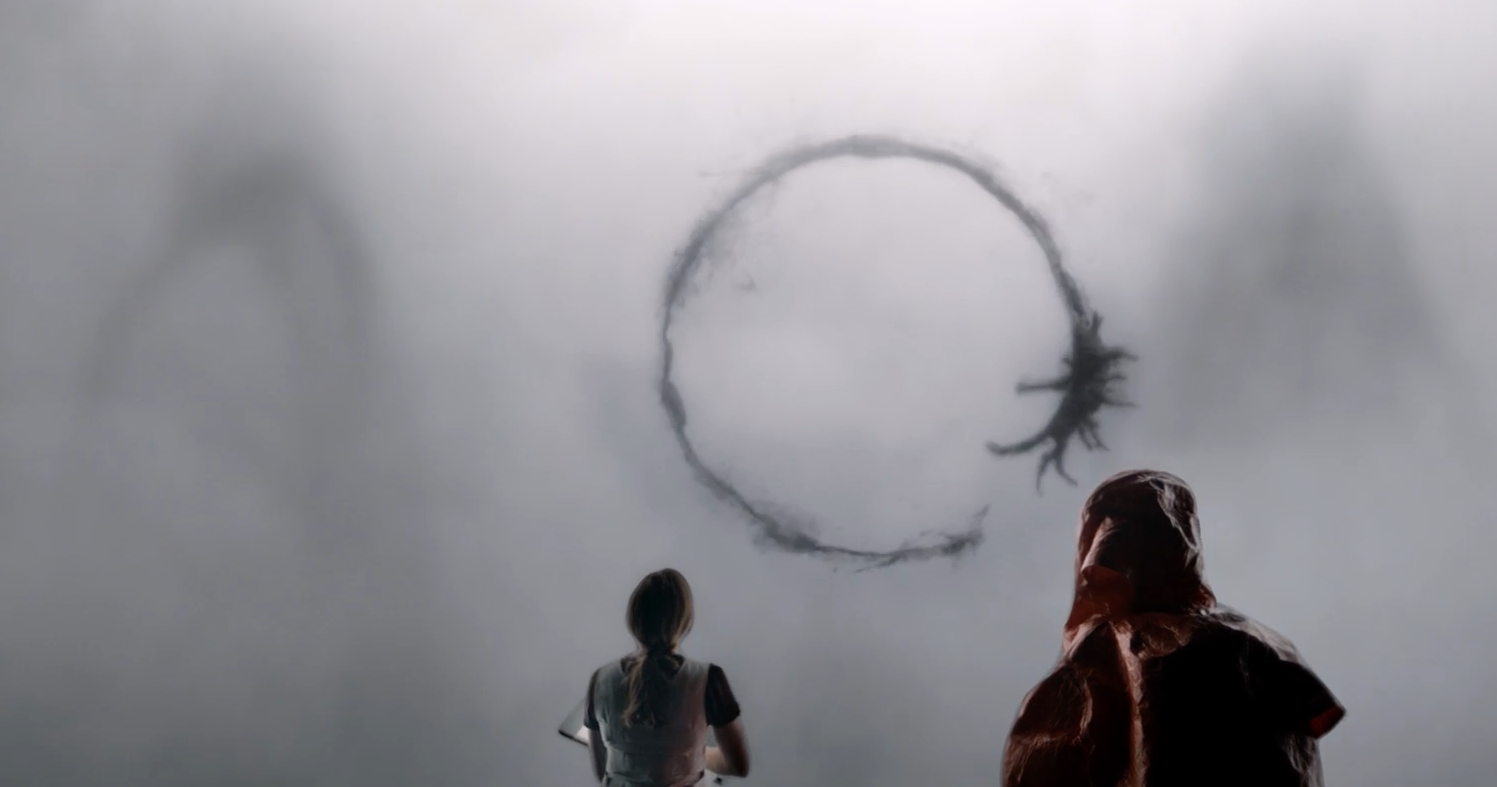
The graphic form of the Heptapods’ language resembles the calligraphy of Zen Buddhist monks. The basis of all the symbols is a circle — ensō — which in the Zen tradition is connected with spirituality and with the process of drawing closer to enlightenment.
Ted Chiang, the author of the short story, calls this written version Heptapod B and separates it from the oral Heptapod A — by analogy with the Mycenaean scripts Linear A and Linear B. The symbols of Heptapod B have no sound expression; they are not made of phonemes or syllables but are ideograms — signs that express information and concepts directly. It is thus a case of semasiography, examples of which we also know from the human world: mathematical notation, musical notation, road signs or the visual icons of computer programs.
The graphic language Heptapod B is exceptional. For the individual symbols, as I have already suggested, there is no sound expression. Whereas in the Latin alphabet each letter corresponds to some phoneme (a sound of the oral form of the language), in Heptapod B this relation does not exist, and instead of the traditional linguistic elements — such as phonemes, morphemes or syllables — the symbols express information or a thought. They are thus ideograms or, more generally, as the author himself describes them in the story, semasiograms, that is, signs that represent information and concepts directly. Other real examples of semasiography are mathematical notation, musical notation, road signs or, say, the visual icons of the text editor I am using at the moment.
Humankind knows semasiographic symbols and relies on them every day, when we travel to work or when we work, and in this respect Heptapod B is not all that interesting. Its exceptionality, and the uniqueness of the Heptapods as a space-faring race in general, lies in the fact that a single symbol hides several meanings at once, all expressed simultaneously by that one symbol, and that this symbol has no beginning and no end; it cannot be read like a classic text of connected sentences, where each sentence follows on from the next one by one and they keep logical relations among themselves. Heptapod B does not contain this linearity, and that is why Dr Banks, in one scene of the film, can blurt out in her memorable eureka moment that Heptapod B is “a non-linear system of orthography”. To the uncomprehending characters watching her, Banks explains:
LOUISE
He [meaning one of the Heptapods] starts at two opposite points and completes the sentence by joining them into a kind of loop. But to do this means he has to have the whole thing in his head before he begins. Every detail. The spacing has to be right or else you wind up with fragments; a mess. (beat) It’s more impressive than that. He wrote the mirror image of it. It’s reversed, so we can read it.
COLONEL WEBER
So? They’re good at writing?
LOUISE
That’s a result of the way they think.
It’s like they know everything they’re going to say before they say it.
The preceding conversation reveals a crucial insight to us. The Heptapods are in some way freed from the linear line of time, which allows them to move their minds about in time in various ways. Time for them is not a one-way road but rather a vast metaspace without borders, which they perceive all at once and into whose chosen parts they can “zoom” at will. The language Heptapod B thus reflects the unique cognitive properties of the Heptapods. How realistic is something like this, and what does language have to do with thinking at all?
The story draws its main idea, that language influences thinking, from a well-known and controversial linguistic theory, the so-called Whorf–Sapir hypothesis (WSH), which was formulated by the researcher Sapir in 1929 and subsequently elaborated by his student Whorf (Sapir-Whorf Hypothesis, Oxford English Dictionary). The core of the hypothesis says that language (and above all its grammar) influences how the native speakers of a language structure the world around them. Whorf’s original ideas can be summarised as follows:
- Thinking is quite clearly dependent on language
- The grammar (not the vocabulary) of a language defines the relation between thinking and language
As early as 1928, in his article The Status of Linguistics as a Science, Sapir writes: “The fact of the matter is that the ‘real world’ is to a large extent built up on the language habits of the group. No two languages are ever sufficiently similar to be considered as representing the same social reality.” The above can be interpreted to mean that although translation between languages is possible, because words are replaceable, we will never achieve a result that does not lose something of the original in the process. For according to this hypothesis it is precisely grammar that influences thinking much more deeply. For both Whorf and Sapir, however, grammar is entirely a product of the cultural development of a given group of people, and in this their views differ from more recent linguistic theories, such as the one Noam Chomsky worked on, whose concept of Universal Grammar claims, on the contrary, that grammar is shared across cultures, and at the lowest, biological level of the brain. For Chomsky and his followers, language is first and foremost about grammar (syntax), which in a very abstract form is a simple computational mechanism that developed in the brain through the process of Darwinian evolution. Although the WSH is interpreted in various ways, thanks to Whorf’s influence it acquired a form from which its basic building blocks can be inferred. Whorf, inspired by Jung’s Gestalt psychology, distinguishes two kinds of thinking:
- isolates of experience
- isolates of meaning
Isolates of experience are a process of segmenting reality, not a process of thinking; it is a non-linguistic process that is common to all people and is independent of language (Lee, 1996, pp. 96–122; Whorf, 1939, pp. 163–64). In other words, if there is a hammer lying on a table, then according to Whorf it is not the case that the grammar of a language would influence the thinking of two different speakers so that they would not see in front of them the same table with the same hammer lying on it. On the other hand, isolates of meaning “are concepts in the speaker’s mind (thoughts)” that grasp the isolates of experience (and thus the external physical world) in a certain, culturally specific way, so that the speaker can assign some meanings to the isolates of experience.
Although Ted Chiang says in one interview that before writing his story he spent a couple of years immersed in the scholarly linguistic literature, one certainly cannot deny the author the artistic licence with which he worked the WSH into his story. The idea that linguistic relativism could be so powerful as to influence the physical world directly is, of course, nowhere to be found in the work of Whorf or of Sapir. What is more, Whorf, as we saw above, says that grammar has no influence on the external physical world (the isolates of experience).
That Chiang did not stay faithful to the linguistic theory does not trouble me that much. I thought much more about the way the story explains the time travel the Heptapods are endowed with. If I am not mistaken and have not overlooked something, the whole plot — of both the story and the film — is explained by and rests on the short quotation from the screenplay given above: Dr Louise Banks claims there, and now I am paraphrasing, that writing the symbols is very complicated and that before the writing even begins, the speaker has to know in advance every fine detail of exactly what they want to say (draw). Honestly, I expected a somewhat more sophisticated explanation.
It is clear that a human being can manage something like this only with great difficulty. Even such an excellent linguist as Dr Banks will need several years before she masters Heptapod B fluently. Still, I have no idea why the speed with which the Heptapods draw their symbols should convince the reader/viewer that such a language not only influences the perception of the physical world but breaks the physical laws known to us. It is not out of the question that humankind may discover such laws in the future. But that is not the argument used in the film, where it really is solely and precisely about how complicated and different the language Heptapod B is.
I would much more willingly accept that Heptapod B is child’s play for its alien native speakers simply because their cognitive abilities and some kind of intelligence quotient fundamentally exceed even the most talented members of the human race. After all, let us remember that John von Neumann, who possessed one of the fastest minds of all time, was also said to be “from another world”, to “belong to a new human species”.
But was I really so disappointed by the story and the film because I cannot swallow the speculation about aspects of scientific theories described above? Not at all. Let this very text be the proof. Immediately after the film ended and I had shaken off the excellent audiovisual experience (as far as the soundtrack is concerned, it is true that even Arrival did not avoid the by now rather kitschy sound effect meant to dramatise certain scenes, which appears in practically every other trailer for new, mostly action-oriented films), I decided that I wanted to respond to the film in writing, so that I could sit down in peace and think through the mechanics of the story. For it is one of the most inspiring and original ones I have seen recently. Arrival owes this, of course, to the original short story, whose author has thereby made his way from the sci-fi underground into the film mainstream. And that is a good thing.
P.S.: One more spoiler alert: that opening scene is not, in fact, entirely the opening.
References
Lee, P. (1996). The Whorf Theory Complex: A Critical Reconstruction. Philadelphia: John Benjamins B.V.
Whorf, B. L., (1939). Gestalt Technique of Stem Composition in Shawnee.
Whorf, B. L., (1940). Linguistics as an Exact Science.